Fed Holds Rates Amid Trade Uncertainty, BoJ Cautious on Future Hikes
2025-03-20 10:39:10


JPY: Limited Impact from BoJ Policy Update
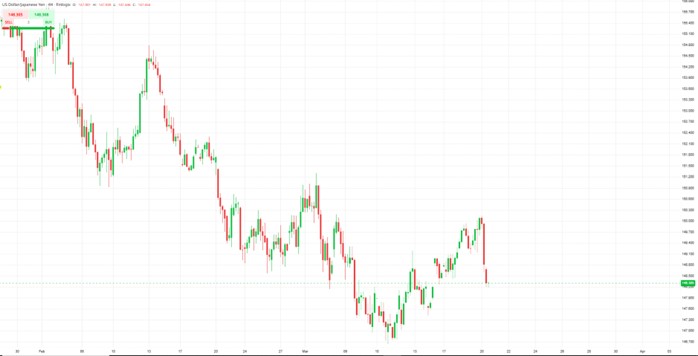
The Japanese yen remains under pressure following the Bank of Japan’s (BoJ) latest policy meeting. While the central bank held rates steady at 0.50%, Governor Ueda’s comments reinforced a cautious stance. Despite an encouraging labour market, where wage hikes appear to be broadening, the BoJ refrained from offering clear signals on the timing of future rate hikes. Market expectations are pricing in gradual rate increases by mid-year, but uncertainty surrounding U.S. policies—particularly potential tariff actions—adds a layer of hesitation to BoJ’s next steps.
Governor Ueda acknowledged growing global uncertainties, particularly as the U.S. accelerates its trade policy revisions. The anticipated announcement of reciprocal tariffs by President Trump in early April—targeting autos, semiconductors, and pharmaceuticals—could significantly impact Japan’s economic outlook. The BoJ’s next meeting on May 1 will likely provide more insight into its policy trajectory, but for now, the lack of decisive action has left the yen vulnerable.
USDJPY H4 Chart
USD: Fed Expected to Hold as Inflation Risks Linger
The Federal Open Market Committee (FOMC) concluded its March 18-19, 2025, meeting by maintaining the federal funds rate at 4.25%–4.50%. This decision reflects the Committee's cautious approach amid heightened economic uncertainties, particularly those arising from recent trade policies.
Revised Economic Projections:
- GDP Growth: The FOMC has adjusted its real GDP growth forecast for 2025 downward to 1.7% from the previous estimate of 2.1%. This revision accounts for the anticipated dampening effect of recent import tariffs on economic activity.
- Inflation: The inflation projection for 2025 has been raised to 2.7%, up from the earlier forecast of 2.5%. This uptick is attributed to the inflationary pressures stemming from the new tariffs.
- Unemployment: The unemployment rate is expected to remain stable at 4.1%, indicating continued strength in the labour market despite other economic headwinds.
Policy Implications:
Despite the current pause, the FOMC's projections suggest the possibility of two quarter-percentage-point rate cuts by the end of 2025. This anticipated easing reflects concerns over slowing growth and the potential need to support economic activity in the face of trade-related uncertainties.
Fed's Stance Amid Trade Tensions:
Chair Jerome Powell emphasized a patient and data-dependent approach, highlighting the significant uncertainty surrounding the economic impact of recent trade policies. The Fed plans to closely monitor incoming data to assess the tariffs' effects on inflation and overall economic performance before making further policy adjustments.
Market Reactions:
Financial markets have responded positively to the Fed's cautious stance, with notable gains observed in major indices. However, businesses express concerns over potential cost increases due to tariffs, which could be passed on to consumers, thereby influencing future inflation trends.
In summary, the Federal Reserve's latest projections underscore a delicate balancing act: supporting economic growth while navigating the complexities introduced by recent trade policies. The commitment to a patient and flexible policy approach aims to sustain economic stability amid these evolving challenges.
DXY 15 Minutes Chart

This content may have been written by a third party. ACY makes no representation or warranty and assumes no liability as to the accuracy or completeness of the information provided, nor any loss arising from any investment based on a recommendation, forecast or other information supplies by any third-party. This content is information only, and does not constitute financial, investment or other advice on which you can rely.
延伸阅读