How Iran and Israel Landed in a Surprise Ceasefire
2025-06-24 12:17:22



Over the past two weeks, tensions between Iran and Israel reached their highest point in years. It began with Israel launching a series of precision strikes aimed at suspected Iranian nuclear infrastructure, allegedly in retaliation for Iranian support of proxy actors in the region.
On Red is possible to see where Israel strikes Iran, on yellow we can see US strikes and in green we have the nuclear facilities
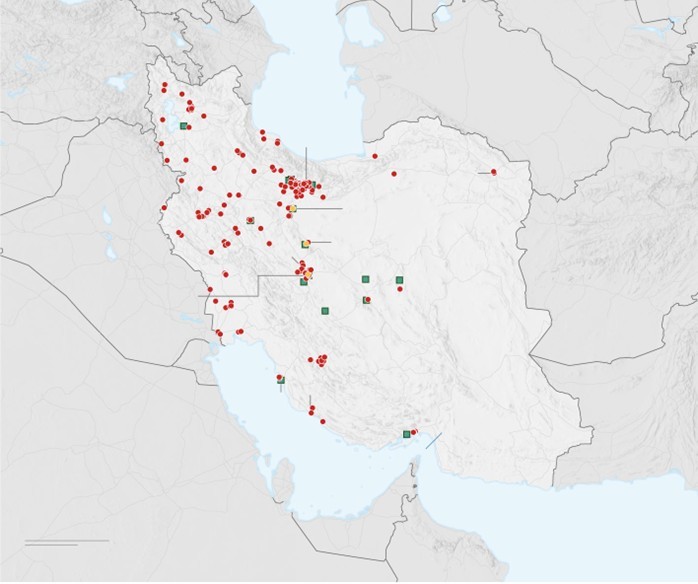
Iran, in turn, escalated by targeting U.S. military installations in Qatar, marking a dangerous widening of the conflict that risked dragging Washington into a direct military confrontation.
In the backdrop of this kinetic exchange was a broader strategic chessboard: Iran sought to project regional dominance and resist Israeli and Western pressure on its nuclear and ballistic missile programs, while Israel aimed to degrade Iran’s military capacity without triggering a full-scale war.
Markets reacted accordingly. Oil prices spiked as fears mounted over a potential closure of the Strait of Hormuz a key chokepoint for global crude flows. Risk assets retreated. Investors leaned into safe havens like the USD and gold, while the Swiss franc also gained on geopolitical jitters. Equities, particularly in Asia and Europe, traded lower on fears of broader conflict contagion.
But through it all, one key variable remained: Washington's strategic posture. And overnight, that variable suddenly moved.
Trump Declares “12 Day War” Over in Surprise Ceasefire Announcement Between Iran and Israel
What Just Happened with Iran and Israel?
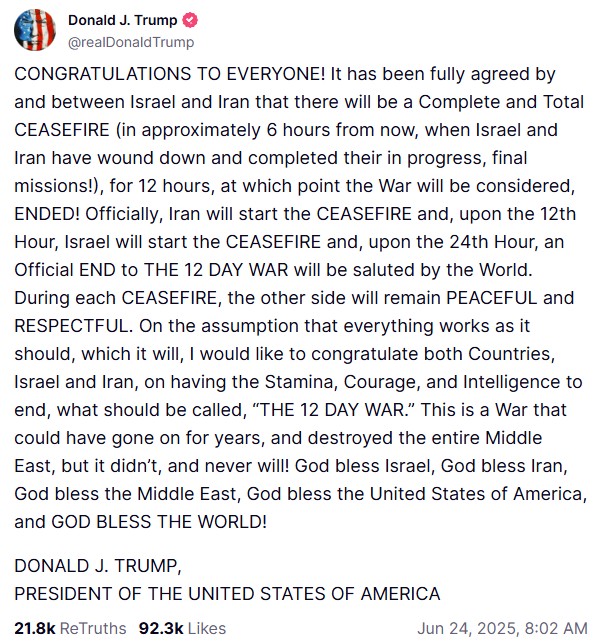
At approximately 10:30 p.m. ET on June 23, U.S. President Donald Trump posted a statement on Truth Social claiming that Iran and Israel had agreed to a “complete and total ceasefire.” According to Trump, the agreement was brokered with the help of Qatar and involved a staggered de-escalation:
- Iran would halt operations first, within six hours of the agreement.
- Israel would reciprocate six hours later.
- Within 24 hours, all military actions would cease, marking the end of a 12-day war.
Trump framed it as a diplomatic breakthrough, emphasising the importance of U.S.-Qatari mediation and painting himself as a broker of peace.
The markets immediately took notice Asian equity indices rebounded, and safe-haven flows began to unwind.
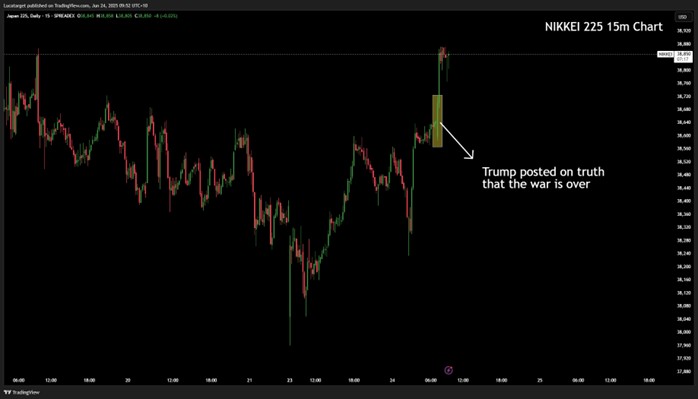
But here’s the catch: neither Iran nor Israel have formally confirmed the ceasefire. No official press release. No televised statement. No military stand-down orders made public. This has led some in the intelligence community to approach the development with caution, for now.
So, Is the War Over Between Iran and Israel?
At face value, there’s no denying that kinetic activity between the two states has dropped dramatically overnight.
Surveillance indicates a temporary standstill, and there are no reports of new strikes from either side. But diplomatically, things remain opaque.
The lack of official confirmation from Jerusalem and Tehran leaves a cloud of uncertainty.
What’s clear, however, is that Trump’s announcement has had a psychological impact on the markets, on political narratives, and potentially on the battlefield.
It’s possible that both countries are using this unofficial ceasefire as a cooling-off mechanism, giving them breathing room to reassess their positions without committing to a public deal.
What Should Forex Trader be Watching at this Moment?
For traders and investors, this moment is pivotal. A confirmed ceasefire could unlock a short-term risk-on rally across equities and some of the FX currencies like, AUD, NZD, JPY, CNH. But if this proves to be a diplomatic bluff or simply an unratified political stunt volatility could return quickly and WTI could reverse and gain strength with that strong oil could impact for a stronger CAD.
Here’s what to watch:
- Confirmation or denial from Israeli or Iranian officials in the next 24–48 hours.
- Movements in crude oil, which has already begun to retrace lower on de-escalation hopes.
- Safe haven unwinding, particularly in JPY and USD, if the ceasefire holds.
Here is What to Trade with Israel and Iran Ceasefire:
If all of this is a Bluff:
We could see WTI coming back above the price that it was before, therefore longing oil could be a good opportunity
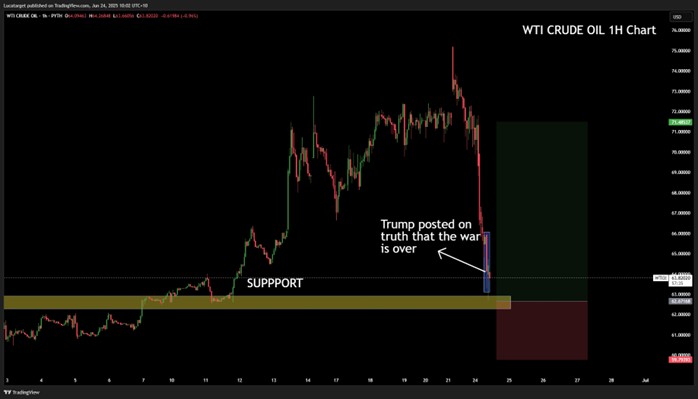
If all of this is NOT a Bluff:
CAD will lose strength due to the WTI prices continue to fall, therefore market would turn risk on, currencies like NZD, AUD will gain strength, therefore a long NZD/CAD, AUD/CAD could be a good opportunity
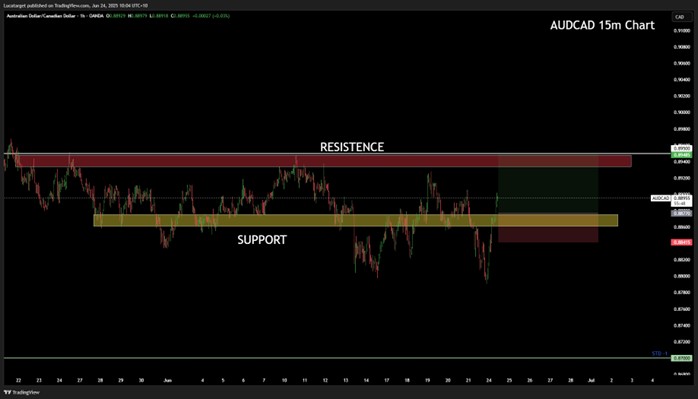
In geopolitics, messaging can be as powerful as missiles. And while the guns may have gone silent overnight, the silence itself is strategic. Whether this ceasefire holds or unravels under pressure will shape the next wave of global risk sentiment.
For now, markets are cautiously optimistic. But as always in the Middle East, quiet skies don’t always mean peace.
Q: Who announced the ceasefire between Iran and Israel?
A: U.S. President Donald Trump announced on Truth Social that Iran and Israel had agreed to a complete and total ceasefire, brokered with help from Qatar. However, no official confirmation has been issued by either Iran or Israel.
Q: What is the ceasefire arrangement Trump described?
A: The ceasefire is structured in phases:
- Iran stops military operations first (within six hours).
- Israel follows 12 hours later.
- After 24 hours, all military activity ceases, officially ending what Trump called the "12 Day War."
Q: What’s the big takeaway for now?
A: Messaging in geopolitics can move markets even before bullets stop flying. Whether this ceasefire holds or falls apart will shape sentiment in FX, commodities, and equities in the days ahead. For now, the market is cautiously optimistic but as always in the Middle East, silence isn’t always peace.
This content may have been written by a third party. ACY makes no representation or warranty and assumes no liability as to the accuracy or completeness of the information provided, nor any loss arising from any investment based on a recommendation, forecast or other information supplies by any third-party. This content is information only, and does not constitute financial, investment or other advice on which you can rely.
延伸閱讀