Gold Gearing for Momentum: Central Bank Demand and Incoming Fed Pause Fuel Bullish Outlook
2025-05-06 13:51:52


After a brief pause to start the month, gold is back in focus—reasserting its safe-haven dominance amid rising global uncertainties and resilient demand from central banks.
- Gold rebounds post-NFP, defying dollar strength as markets anticipate a Fed rate pause and eventual cut.
- Central banks drive long-term support, with Q1 gold purchases up 24% above the 5-year average and forecasts pointing toward record demand.
- Geopolitical flashpoints and trade tensions continue to lift safe-haven demand, solidifying gold’s role as a global risk hedge.

Since May 2, gold (XAU/USD) has managed to push higher, navigating through a mixed bag of U.S. economic data, geopolitical flashpoints, and growing market anxiety over trade and global leadership. While the U.S. dollar briefly firmed on strong NFP data, gold’s upward resilience has underscored a broader narrative: investors are preparing for volatility—and gold remains the asset of choice.
U.S. Jobs Data Gives Dollar a Lift—but Gold Holds Firm

Gold's recent rally began in defiance of a stronger-than-expected U.S. Non-Farm Payrolls report released on May 3. With 177k jobs added in April and unemployment steady at 4.2%, the U.S. dollar received a temporary boost, dragging gold slightly lower in the initial hours.

This allowed the greenback to hold its ground and get a slight push up back at the daily volume balance sitting at 100.163 - 100.700.
However, gold’s refusal to break below $3,200 signaled underlying strength. Traders quickly recalibrated expectations, betting that the Federal Reserve’s rate-hold stance may stay longer than previously thought. This subtle shift in sentiment helped gold bounce back, especially as real yields remained relatively subdued.
Fed Rate Pause: A Breather Before Potential Cuts


The Fed is expected to hold rates steady this Thursday, offering gold a short-term boost. Markets see this pause as a breather before a potential rate cut in Q3—likely weakening the dollar and driving renewed demand for gold as a safe-haven. With lower rates reducing the cost of holding gold, and uncertainty still high, investor appetite remains strong.
Central Bank Demand: A Key Driver of Gold's Bullish Momentum

Central banks have continued to play a pivotal role in supporting gold prices in 2025. In the first quarter alone, net purchases totaled 244 tonnes, marking a robust demand that, while slightly lower than the previous quarter, remains 24% above the five-year quarterly average.
Notable Central Bank Purchases in Q1 2025:
- Poland: The National Bank of Poland led the pack by adding 49 tonnes, bringing its total gold holdings to 497 tonnes, which now constitute 21% of its total reserves.
- China: The People's Bank of China increased its reserves by 13 tonnes, reaching a total of 2,292 tonnes, accounting for 6.5% of its total reserves.
- Kazakhstan: Added 6 tonnes, bringing its official gold reserves to 291 tonnes.
- India: The Reserve Bank of India purchased 3 tonnes, with total holdings at 880 tonnes, making up 12% of its reserves.
- Turkey: Increased its reserves by 4 tonnes, totaling 623 tonnes, which is 38% of its total reserves.
- Other Notable Buyers: Qatar (3t), Egypt (1t), Czech Republic (5t), and Azerbaijan's State Oil Fund (19t).
This sustained accumulation underscores a strategic shift among central banks to diversify reserves and hedge against economic uncertainties.
Goldman Sachs' Bullish Gold Forecast
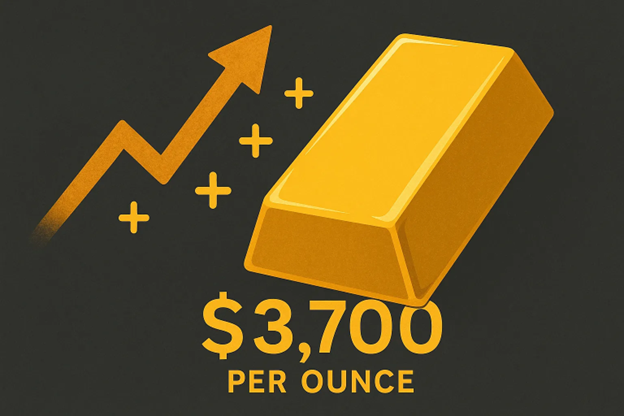
Reflecting on these developments, Goldman Sachs has revised its year-end gold price forecast to $3,700 per ounce, up from the previous estimate of $3,300. The bank attributes this upward revision to stronger-than-expected central bank demand and increased investments in gold-backed ETFs amid rising recession risks.
Goldman Sachs now projects that central banks will purchase an average of 80 tonnes per month in 2025, significantly higher than the pre-2022 average of 17 tonnes per month.
Geopolitical Tensions Spark Fresh Safe-Haven Demand

Beyond economic data, it’s global geopolitics that are giving gold its biggest push. Over the past week, headlines have continued to stir investor caution:
- Middle East Instability: Renewed tensions between Iran and Israel have kept gold elevated as markets price in risk premium.
- Russia-Ukraine Update: Russian President Vladimir Putin signaled intentions to resolve the Ukraine conflict—but without specifics, traders remain wary.
- U.S.-China Trade Tensions: President Trump’s proposal of a 100% tariff on foreign films reignited fears of a broader trade escalation. This, combined with unresolved tech policy disputes, pushed risk sentiment lower and boosted flows into gold.
Daily

Gold is currently trading at $3,300+ level. After a bounce from the daily volume imbalance at 3233.59 - 3282.20, gold is now gearing up for a renewed potential upside. As long as we don’t trade back again and below $3,200 level, we could see gold to hold its ground and push up higher.
Gold Remains the Anchor in a Shifting Market

From central bank buying to renewed geopolitical stress, gold has proven that it's more than just an inflation hedge—it’s a global stabilizer when everything else feels uncertain. While the dollar may recover in bursts, and U.S. data may cause short-term fluctuations, the structural case for gold remains firm.
"In markets driven by fear and speculation, gold stands as the one constant—silent, steady, and essential."
Check Out Our Market Education
Learn how to navigate yourself in times of turmoil. Check out my market education links:
Want to learn how to trade like the Smart Money? Check out my new contents:
https://acy.com/en/market-news/education/smc-playbook-series-beginners-guide-j-o-04032025-155530/
Follow me on LinkedIn: https://www.linkedin.com/in/jasperosita/
This content may have been written by a third party. ACY makes no representation or warranty and assumes no liability as to the accuracy or completeness of the information provided, nor any loss arising from any investment based on a recommendation, forecast or other information supplies by any third-party. This content is information only, and does not constitute financial, investment or other advice on which you can rely.