Stuck in the Strait: Why the Euro Can't Break the Dollar's Energy Shield?
2026-04-07 14:12:39


EURUSD: Can the EURO Break Out Amid Rising Inflation?
A brief relief bounce in the Euro was quickly overshadowed by the U.S. ISM Services PMI report released on April 6, which has fundamentally shifted the week’s risk profile.
- US Data: While the headline Services PMI registered 54.0% (against a 54.8% forecast), marking 21 months of expansion, the real shock came from the Prices Index, which surged to 70.7%, its highest level since late 2022.
- Macroeconomics: This serves as a warning of Stagflationary pressure (stagnating growth paired with rising prices). While the service sector remains in growth territory, the cost of providing those services is climbing rapidly, driven largely by fuel and energy spikes stemming from the Middle East conflict.
- Market Implication: This data suggests that inflationary pressures are much more persistent than the Federal Reserve anticipated. For the EUR/USD, this reinforces the higher-for-longer interest rate narrative, making it extremely difficult for the Euro to sustain gains above the 1.1560 level.
The April 6 Deadline
The diplomatic deadline for Iran to reopen the Strait of Hormuz passed yesterday without a resolution, ensuring that the energy-driven supply-shock premium remains a core driver of Dollar strength.
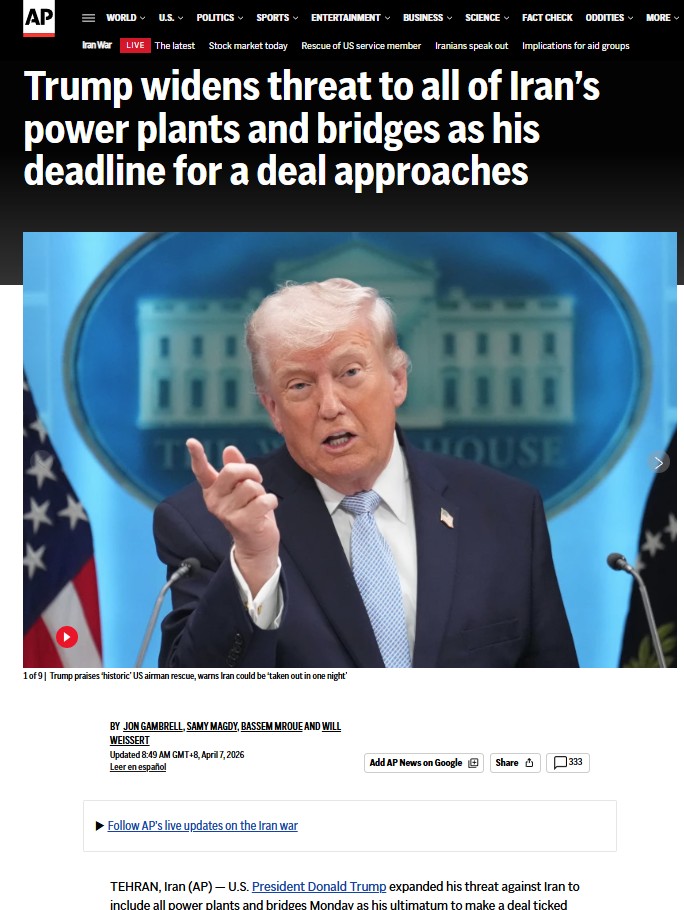
Conflicting reports regarding a U.S.-led ceasefire proposal have kept the market on edge. Despite optimistic signals from the U.S. administration, Iranian officials maintain that the Strait remains under their full control.
This ongoing uncertainty creates a Safe-Haven Floor for the USD. Investors are hesitant to exit Dollar positions while critical global energy infrastructure remains at risk. Consequently, the Euro’s relief rally is hitting a wall because the underlying geopolitical risk the Dollar's Energy Shield has not dissipated.
Technical Analysis at 1.1610 Resistance (Ceiling)
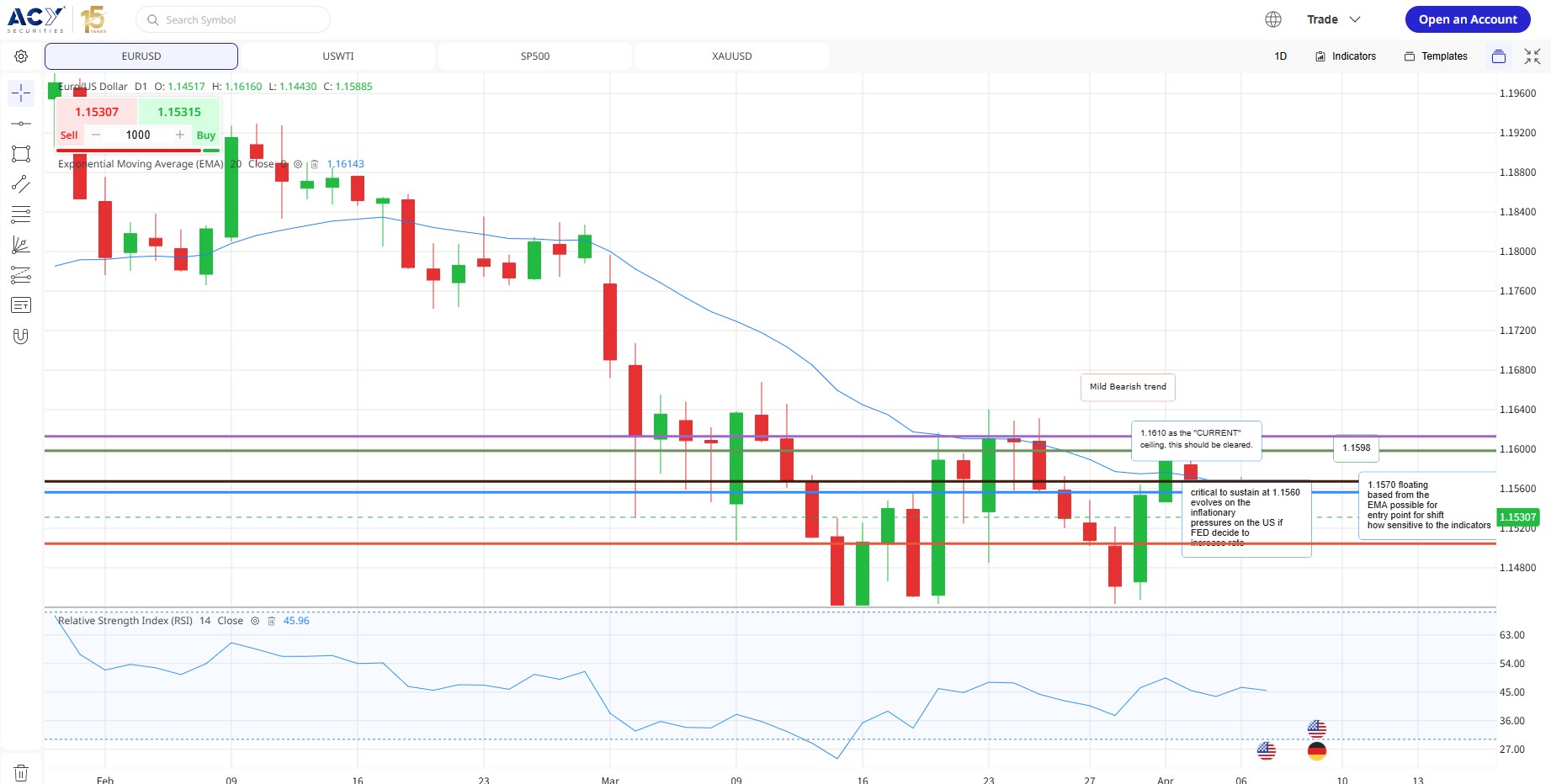
The pair continues to trade with a mild bearish bias, floating below the 20-day Exponential Moving Average (EMA) near 1.1570.
The EUR is currently squeezing near the bottom of its recent range. While the 14-day Relative Strength Index (RSI) shows an attempt at a recovery, the pair remains trapped below the critical 1.1598–1.1610 resistance zone.
While some may interpret current price action as mere consolidation, we characterize this as a period of Directional Stagnation, a volatility trap where technical levels lack fundamental backing. Until the Euro decisively clears the 1.1610 resistance, any upward momentum should be viewed as a fragile technical correction. This price behavior is typical of the thin liquidity observed in post-holiday markets and lacks the necessary macroeconomic conviction to challenge the prevailing bearish trend.
- Context: On the price chart, the Euro has repeatedly failed to break above the 1.1610 level.
- Macroeconomic Implication: Failure to break a resistance (ceiling) during a low-volume holiday period confirms the dominant Bearish trend. Expect a slide back toward 1.1500.
Energy-Driven Supply Shock Premium
- Context: The April 6 deadline passed without a resolution for the Strait of Hormuz.
- Macroeconomic Implication: When global trade routes are at risk, investors move capital into the U.S. Dollar. This Shield prevents the Euro from making serious gains.
U.S. Data on Sticky Inflation
- Context: The ISM Services (Purchasing Managers' Index/PMI) report showed surging input prices.
- Macroeconomic Implication: The Federal Reserve is trapped, they cannot cut rates while inflation is this high. This creates a widening yield advantage for the Greenback.
Euro Fundamentals on Industrial Engine Stalling
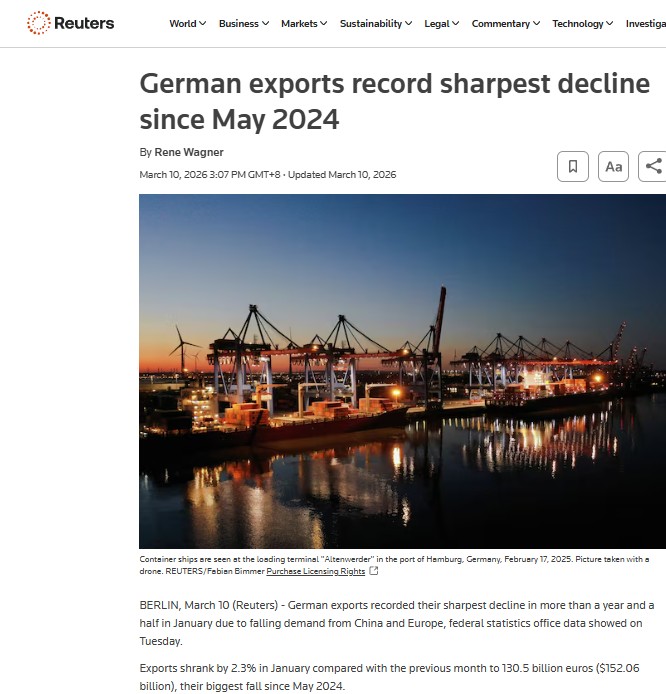
- Context: Germany reported a 2.3% contraction in exports.
- Macroeconomic Implication: If Germany’s trade is shrinking, the Euro loses its fundamental backing, signaling that the economy is too weak to support a higher currency value.
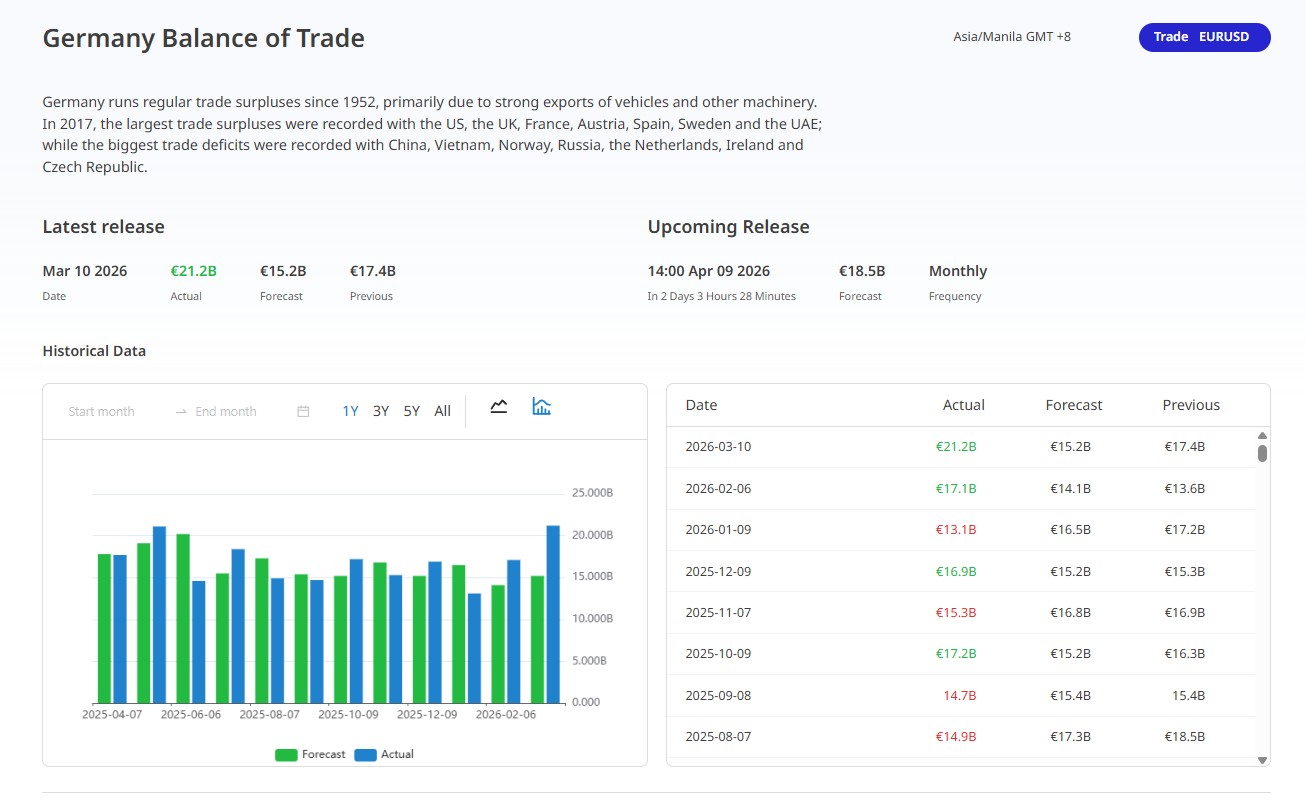
ECONOMIC INDICATORS TO SUSTAIN EURO FOR THE WEEK
Euro Area Retail Sales – April 8
- Market Expectation: (Surplus beat) A print exceeding the consensus forecast.
- Strategic Rationale: Consumer resilience is a primary pillar for an internal recovery. If European household spending remains robust despite elevated energy costs, it suggests the economy is better positioned to absorb current shocks than the Stagflation narrative implies. Stronger data here provides a fundamental catalyst to bid the Euro.
Germany Industrial Production – April 8
- Market Expectation: (Positive reversal) A meaningful recovery following the previous month's contraction.
- Strategic Rationale: As the industrial core of Europe, Germany’s manufacturing health is vital for currency stability. Following the recent 2.3% drop in exports, the market requires evidence of production stabilization. An upside surprise would mitigate recessionary fears and help the Euro challenge the 1.1610 resistance.
Euro Area Industrial Producer Prices (PPI) – April 8
- Market Expectation: (Sustained Elevation) Evidence of persistent price pressures.
- Strategic Rationale: While high costs are tough for business, they are bullish for the Euro. Persistent price pressure means the ECB (European Central Bank) must keep interest rates high. This narrows the gap between European and American rates, giving the Euro a much-needed boost.
Industrial Production (Major Economies) – April 10
- Market Expectation: Synchronized growth across Germany, France, and Italy.
- Strategic Rationale: For a sustainable EUR rally, the recovery must be broad-based rather than isolated to a single nation. Positive momentum across the Eurozone's leading economies would signal that the region is managing the Middle East energy crisis more effectively than anticipated.
Retail Sales (Consumer)
- Outcome: A Surplus (the data comes in higher than what the experts predicted).
- Market Implication: Sustained consumer spending serves as a key indicator of economic durability against current geopolitical volatility. If the Eurozone's internal growth engine continues to function despite high energy premiums, it reinforces the currency's fundamental floor and justifies a shift in investor sentiment toward a more bullish Euro outlook
German Production (Industrial)
- Outcome: A Positive Reversal (the factories are finally making more goods after the recent slump).
- Market Implication: Because Germany is the primary engine of the European economy, a boost here is the best way to fight off the bad news about falling exports. If German factories pick up speed, it shows the export drag (the damage caused by the war) is starting to fade.
Producer Prices Index (European Central Bank Mandate)
- Outcome: Sustained Elevation (prices paid by factories stay high).
- Market Implication: Usually, high prices are a bad thing, but for a currency, it is a bullish signal. It forces the ECB (European Central Bank) to keep interest rates high to fight inflation. When the ECB keeps rates high, the Euro becomes a more attractive place for global investors to park their cash compared to other currencies.
U.S. CPI (Consumer Price Index)
- Outcome: Deceleration (inflation in the U.S. starts to slow down).
- Market Implication: A Euro breakout requires a weaker Dollar story. Lower U.S. inflation would reduce the Dollar's appeal as a high-yield safe haven. Once that pressure is gone, the Euro will finally have the room it needs to climb past the 1.1610 resistance level.
Conclusion & The ACY Edge
We remain neutral-to-bearish while the Euro consolidates below the 1.1610 level. This 'stagnation' phase suggests limited upside potential; the pair remains at risk of a deeper correction as long as the current energy-related supply shock keeps the U.S. Dollar supported.
Disclaimer: This content may have been written by a third party. ACY makes no representation or warranty and assumes no liability as to the accuracy or completeness of the information provided, nor any loss arising from any investment based on a recommendation, forecast or other information supplies by any third-party. This content is information only, and does not constitute financial, investment or other advice on which you can rely.
Try These Next